
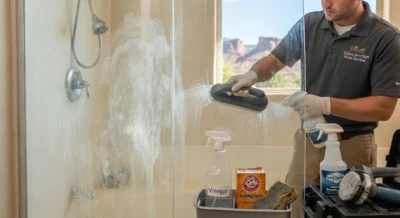
 You wipe the glass shower door, it looks great for a day, and by the weekend the cloudy film is back. Faucets grow a chalky crust, and the kettle gets a gritty lining. Hard water cleaning in Grand Junction is one of those chores that never feels finished, because the minerals come back every time the tap runs. This post is for homeowners in Grand Junction, Fruita and Palisade who want to know what genuinely works at home, what to avoid so you don’t ruin a surface, and where the honest cutoff sits between a Saturday of scrubbing and calling someone.
What mineral buildup is and where it shows up first
Hard water simply means the water carries dissolved minerals, mostly calcium and magnesium. They stay behind when water evaporates: the water leaves, the rock does not. Water in much of the Grand Valley is noticeably mineral-heavy, which is why so many homes here fight the same white film year after year.
The buildup starts where water sits or sprays:
- Glass shower doors — the flat, cloudy haze that shrugs off ordinary bathroom spray
- Faucets, showerheads and handle bases — crusty rings and reduced flow
- Faucet aerators — the tiny screen that clogs and turns a clean stream into a sputter
- Dishwasher interiors and electric kettles — chalky scale on elements and racks
- Toilet bowls — the ring right at the water level
- Exterior windows — sprinkler-overspray spotting, common on Redlands and Orchard Mesa homes with lawn zones aimed a little too close to the glass
Catching it early matters more than technique: a two-week film wipes off, but a two-year deposit is a different job.
Hard water cleaning methods that actually work at home
The winning idea is dwell time, not muscle. Mineral deposits dissolve in mild acid, and dissolving takes minutes. Most people scrub for ten seconds and blame the product.
A simple routine for light to moderate buildup
- Pick one mild acid and let it sit. White vinegar or a store-bought lime and scale remover both work on glass and chrome. Soak a paper towel, press it flat against the surface, and leave it 10 to 20 minutes so the product can’t run off.
- Bag the small stuff. Unscrew a showerhead or aerator and drop it in a cup of vinegar, or rubber-band a bag of vinegar around it in place.
- Agitate gently. A non-scratch pad or an old toothbrush around fixture bases. No metal, no grit, no pressure.
- Rinse fully and dry. Everyone skips this. Rinsing carries off loosened minerals, and a squeegee is what actually keeps the haze from coming back.
- Repeat before escalating. Layered deposits often need a second pass, not a harsher product.
Safety and surface rules worth following
| Surface or Product | What to Do | Why It Matters |
|---|---|---|
| Natural stone — granite, marble, travertine | Keep vinegar and acidic descalers off it; use a stone-safe cleaner | Acid dulls and etches stone permanently |
| Glass shower doors | Mild acid plus dwell time, then squeegee dry after every shower | Drying is what prevents the film from rebuilding |
| Chrome and brushed fixtures | Soak, don’t scour | Abrasives leave fine scratches that hold minerals even faster |
| Any two cleaning chemicals | Never mix them, especially bleach with acidic or ammonia-based products | Mixing can create dangerous fumes |
Ventilate, wear gloves, and test new products where nobody looks. And remember that cleaning is not repair: worn caulk needs its own decision.
Tired of losing your Saturday to a shower door? Request an Online Quote. Or Call: 970-361-3408.
Deposits versus etching: the honest distinction
This distinction is the part most cleaning advice leaves out, and it can save you money.
Mineral deposits sit on top of a surface. Dissolve, rinse, dry, and the glass or chrome underneath comes back.
Etching is damage to the surface itself. When minerals and acidic residue work on glass or a finish long enough, they pit and cloud the material. It’s no longer smooth, so it reads as permanently foggy even when clean.
Here’s the practical test: after a full soak-and-rinse, wet the surface and look again. If the cloudiness disappears when wet and returns as it dries, you’re probably looking at etching.
Once glass or a fixture finish is etched, cleaning cannot restore it. That’s a replacement or refinishing decision, not a cleaning outcome. We’d rather say so up front than take a booking to polish away something no product will fix. The same applies to permanently stained grout and worn tub finishes.
When DIY hard water cleaning stops paying off
Plenty of hard-water work is a homeowner job. Here’s where it stops paying off:
- Layered buildup that’s had years to accumulate. A first restorative pass can take hours per bathroom.
- Large glass areas. Frameless enclosures are a lot of surface to keep wet with product and then dry without streaks.
- Rentals and vacation properties between guests. A cloudy shower door photographs badly and shows up in reviews, and turnovers rarely leave room for a 20-minute soak. That’s why Airbnb & VRBO Cleaning is often where hosts in Palisade and Grand Junction hand this off.
- You simply don’t want the Saturday. Completely valid, and it’s most of why people call.
A Deep Cleaning visit fits that first heavy reset, because mineral buildup usually travels with other detail work — grout lines, fixtures, sink edges. After the reset, Recurring House Cleaning keeps film from rebuilding to that point. You can compare the full range on our Cleaning Services in Grand Junction page.
Kokopelli Home Services is locally owned by Dana and Ben Russell, fully insured, and works with a background-checked crew, so you know who’s walking into your home in Grand Junction or Fruita. We’ll tell you honestly what cleaning can bring back and what it can’t — and then you get your weekend back.
Ready to hand off the hard-water scrubbing for good? Request an Online Quote. Or Call: 970-361-3408. Consider It DONE!
Frequently asked questions
What is the best way to remove hard water spots from a glass shower door?
Apply a mild acid such as white vinegar or a lime and scale remover, hold it against the glass with soaked paper towels for 10 to 20 minutes, agitate gently with a non-scratch pad, then rinse fully and squeegee dry. A second pass usually beats a harsher product.
Can hard water damage be permanent?
Yes. Mineral deposits sitting on a surface are removable, but etching is damage to the surface itself and cleaning cannot reverse it. If cloudiness disappears when the glass is wet and returns as it dries, the surface is likely etched, which becomes a replacement or refinishing decision.
Is vinegar safe on all bathroom and kitchen surfaces?
No. Keep vinegar and other acidic descalers away from natural stone such as granite, marble and travertine, because acid dulls and etches it. Avoid abrasive pads on chrome, never mix cleaning chemicals, and test new products in an inconspicuous spot first.
Who Can Deep Clean Hard-Water Buildup in a Home in Grand Junction, CO?
Kokopelli Home Services provides hard-water and deep cleaning throughout Mesa County, Grand Junction, Fruita, Palisade and the entire Grand Valley.
How often should hard water buildup be cleaned in a Mesa County home?
Squeegeeing shower glass after use, plus a short mineral-focused pass every week or two, keeps most film from setting. Fixtures, aerators and kettles usually need a descaling soak a few times a year, and heavier deposits benefit from one thorough reset first.